Purism is in the business of offering "premium", Privacy-preserving software and hardware built with Linux in mind from the ground-up. They have been developing a mobile device called the Librem5 which I have received today. How does it fare?
The Long Road to Getting Hands on the Premium Linux Handheld
In late 2017 I pre-ordered the Purism Librem5, a promising Free Software mobile phone running "real" Linux rather than Android or similar Linux-like environments. Unlike Sailfish, for example, there is no way to run even f-droid Android applications on this device.
They announced they were ready to start shipping early revisions in Sep 2019 after having a very transparent development roadmap -- though certainly not a perfect one. It may "Respect Your Freedom" 🙈🙉🙊 but like all things Free Software there were an incredible amount of caveats.
I preferred to receive a device with early mechanical revisions (the "birch", "chestnut", "dogwood" revisions) but eventually was put in to the Evergreen "final v1 mechanical revision" batch in Nov 2019 scheduled for Q2 2020. Well then COVID-19 happened, supply chains got bad, coordination with locked-down regions of China became impossible, the device slipped to be estimated to ship in April 2021, then to October 2021 when another "New Update" (which I now see says that they sent out "emails to the batches ready for shipment", but no indication that I was in that batch...), then radio silence. In April I received an email from Purism soliciting investment in their company and a self-congratulatory follow up three weeks later. Now in May 2022 I have received my Librem5 after reaching out to their Customer Support to update my shipping address after I moved and I learned that my device has been _sitting in a warehouse for 8 months_:
Hello, I would like to adjust the shipping address for the order Purism_redacted as I've moved recently:
[address obviously excluded]... a reply quickly arrived:
We have sent a pre-shipment email to you on September the 26th last year, we haven't received a response until now. So I have now updated your shipping address and put your pre-order in the shipping queue and prioritized it, should be shipped soon.
Please confirm reception of this email.
Naturally, I don't have any record of such an email, but that's fine, it's not as though I was relying on this device... I replied to the email the next day to confirm receipt. And then once again 5 weeks later I followed up to ask when it would be shipped, and to ask that if it hasn't been shipped yet to ship to a PMB near my home since I don't have secure package storage. That was suitable confirmation, and my device arrived 10 days later.
"Unbelievable!" my friend Ben says. Well, believe it!
...
I pre-ordered the device for 600 $, these are currently being sold with a 52 week lead time for 1300 $. If you want one sooner, you can pay for a Librem5 USA Edition with a 60 day lead time for 1900 dollars. Woof.
Purism, who lists their office address in their contact page as a highrise floor in the expensive San Francisco 94105 Financial District zip code offers for an additional 200 $ an "anti-interdiction" service for their USA-manufactured devices, a safety blanket protecting libretarians who think they're somehow subject to Tailored Access Operations. You'd think this would be rare enough, but it is "surprisingly popular" to finally have a use for PGP email, as "the average customer tends to have some familiarity with email encryption and often already has a key set up, but doesn’t necessarily have a specific threat in mind."
What is the Purism Librem5
The Librem 5 represents the opportunity for you to take back control and protect your private information, your digital life through free and open source software, open governance, and transparency.
It's an ARM device with
an NXP i.MX 8
3gb of RAM
32GB of onboard-flash
a micro-SD card slot
a decent screen (282 PPI at 5.7 inches with 2:1 ratio)
hardware kill switches for cellular, wifi, camera, microphone
an OS that is shared with Purism's desktop and laptop machines - so-called Convergence.
A high-end device from 2015
This spec list is ... perhaps underwhelming when you consider what you can get out of commodity hardware from Android or iOS, even when you only consider devices which can run MicroG LineageOS. If I had to pick an Android phone with representative hardware specifications to compare this device to, I would reach for something like the Samsung Galaxy S6 released in 2015. (incidentally, this device could run run LineageOS Android 10 if you're brave enough to build it all yourself! can't interdict what you took out of a drawer and flashed from official source yourself!)
It doesn't have a fingerprint sensor unlock, much less pattern swipe or root-forbid face recognition unlock. It also has no NFC, which is basically fine since no bank or payment system is gonna issue payments from a GNU/Linux system anyways, but there's no using this device as a transit pass.
The phone is ... big? it's far heavier than either my PinePhone or Moto G android device and thicker, too.
Here it is lined up with an iPhone SE and the PinePhone pmOS edition:


The hardware design itself is pretty unremarkable, a USB-C port on the bottom, a headphone jack on the top, the aforementioned hardware kill switches on the left, and a power button and volume bumper on the right side of the device. There's a utility LED next to the front-faceing camera which is I think a touch that I miss from Android devices, though I am not sure what sort of software uses this right now. It's not used for notifications as far as I can tell.
I guess the reason it is so big is, at least in part, the fairly massive 4550mAh battery. It's nice to know that they didn't skimp on that, but yet the battery life leaves much to be desired. Power management on Linux is kind of a known farce, but I would expect a fully integrated package like this could do better than 5-10 hours of estimated battery life before even powering up the 4G modem.

The camera
The camera is ... not great. "It's complicated":
//puri.sm/wp-content/uploads/2022/05/uvc_vs_Bayer.png
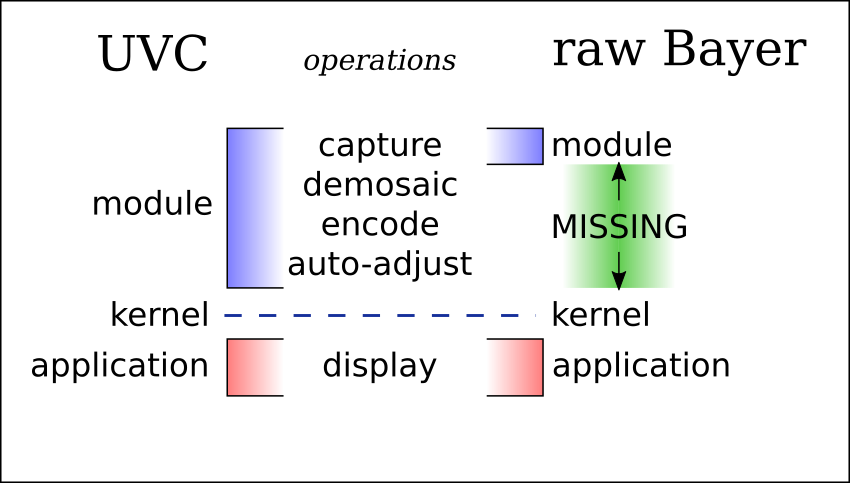
There is no auto-adjustment. You set the exposure, gain, white balance, and focus point by yourself. With enough tweaking you can get something which does not compare to even budget devices. Even with maximum gain and exposure, the photos are significantly darker and noisier than my Moto G:

The Moto G:

There is much work to be done here, and it seems like it's the case with most Free Software support for these systems, it relies on people with enough contextual knowledge of hardware integration, signals processing, adn enough free time and tolerance for providing Free Mutual Aide to improve this situation. If you have these knowledge, and free time, you can discard the desire for mutual aide and net 400k$/year working on hardware integration for a proprietary mobile platform, the equation is tough in that regard. I give folks who do this endless credit, even as I sit here and criticize their work. More on that at the end.
PureOS - Private, Secure Premium Freegan-ware
PureOS is Purism's Debian-based Linux distribution and is the only supported OS option for this device, it is a mobile build of the OS which Purism ships on their Librem laptops. Compare this to the PinePhone which runs a community build of the Manjaro Linux distribution, along with a dozen other distributions with builds supported in XDA-style 2000 post forum threads.
"Well that's Handy!"
They're really going in on libhandy the GNOME "adaptive UI" libraries which integrate with the GNOME development environments, and so this OS is already by default going to go against my aesthetic and usage preferences, but I'll swallow that and see what they have to present. This is fine and all, but I can't help but notice that everything on the phone still talks about "keyboard shortcuts", doesn't provide a lot of "common sense" stuff that I am used to when it comes to mobile application interfaces, like for example holding my finger on text to start highlighting. It also doesn't work so flawlessly:

First User experience
The first-user experience is fine enough but does not offer to change the default passwords -- you're advised in the quick start guide to change your passcode but this does not change the default 123456 passphrase which unlocks LUKS full disk encryption. To do so, you have to be sure to go to the Disks application, clicking in particular the Partition 2: 31GB LUKS, then the little gears below it, and then clicking Change Passphrase......

The quickstart guide seems to imply that the Firstboot program should be able to take configuration for IMAP and SMTP servers but it only offered me Nextcloud configurations. Fine enough, that's what I use, and it automatically included my calendar, contacts, and file access which is quite nice to see for once.
And the half-dozen apps you can install
The PureOS Store lists a dozen or so applications, most of which are already included in the OS by default.
You can toggle a Preference to list all apps which are packaged on the PureOS store but the vast majority will not work well with the mobile shell, even if they run. Many of the categories would appear to have multiple apps, until the metadata loaded after 15-30 seconds, and ... there would be nothing on the screen. One of the eight "Socialize" apps listed is a What is My IP tool. There's a Free Software conference schedule viewer at least.
I installed Tootle and the first "red flag" with the software started to become clear: the WebKit based browser Epiphany AKA Gnome Web would crash trying to load the Cybre Space login page. gulp I tried to run some browser benchmark tests and they also crashed the browser. gulp I tried to load mobile Twitter and it crashed the browser. gulp I tried to open an image in Tootle and it crashed the app. gulp
Searching on the Purism forum I found a thread from three weeks ago talking about a "crashy security update" and the recommendation to downgrade by pulling that security update off of the system. Hmm. I don't really feel comfortable doing that! The good news is that the command is extremely un-fun to type in the terminal with a soft-keyboard and I can't figure out how to highlight page text in Gnome Web when the pages _do_ load. I'll hold off, thanks.
//i.kym-cdn.com/photos/images/newsfeed/001/535/091/d97.jpg

I also tried firefox-esr and firefox-esr-mobile-config and these "worked" but the experience outside of the Handy HIG is strictly a downgrade and the pages loaded glacially compared to Gnome Web or Firefox on Android.
I thought there was supposed to be a Matrix.org client included, I remember seeing quite some promising development, but the only chat support I can find is SMS/MMS or XMPP. hmm. I'll try to run Nheko on it soon enough.
Ah but it runs any Linux app!
Of course this thing is "just" a Linux machine, it's a Debian OS so I can install a slightly out of date version of Emacs with GTK through the terminal! hell yeah! But I'm not sure how to get the "programmer" version of the OSK to appear in Emacs so it's hard to actually ... do anything with it. It'd be hard enough already, but at least with org-mode I could build some simple Hypermedia to accomplish simple organizational tasks like I do on my laptop through CCE. I certainly don't feel like it's worth trying to deploy CCE to this machine right now, though.


The soft keyboard is better than the one which I used on PinePhone Manjaro but a far cry from what you would expect from GBoard or the iPhone keyboard... This is the recurring theme, and it would be fine were it not for the intoxicating expectations of knowledge.
A +600 dollar+ +1300 dollar+ 2000$ investment in a promising toy, or a sprint on a treadmill
Purism promises to continue supporting the development of PureOS and the integration with the hardware, but it's clear to me that there is a long road ahead.
Back when the future was bright and Intel manufactured ARM CPUs, I ran some limited, poorly supported mobile environments like GPE and Qtopia on Linux distributions like Ångstrom Linux on my Palm T|X, this early experimentation of Linux on mobile devices lead to my interest in Free Software and the idea that normal people could build fully integrated software in their own image, or at least get others' work to work for them.

In 2010 while I was involved in KDE's development community in the Plasma 4 transition, I had the opportunity to attend the Akademy developer conference in Finland. One of the most mystical things that I saw demoed there was a version of Plasma running on the Nokia N900. As a recent high school graduate fully steeped in Free Software maximalism I was soooo jealous of the folks running these Linux devices. You can still find recording demos of these early prototypes online. In 2016 I had the resources to grab an N900 off of eBay, and in fact got to finally use Linux as my "primary OS" going so far as to getting my full Emacs distribution running on it and setting up a custom browser to use Uber's mobile web app to get around SF Bay Area using a fully Free Software stack. This didn't last so long, though, I found myself carrying an iPhone SE first as a backup, then as my main squeeze when my friend Tor spent five or ten seconds fiddling with the lock screen and sliding the hardware keyboard and hitting the camera button before handing it back to me with the home screen unlocked.
When I was playing with some early builds of Linux on the PinePhone, I was sad by how these un-optimized N900 demos seemed to actually perform better than un-optimized Plasma 5 did on the PinePhone. Yikes. The "raw performance" of Phosh and Handy apps on the Librem5 meanwhile is actually impressively passable, but the fit-and-finish will in my opinion continue to fall short. Over the course of a decade and change, Linux on mobile has not got better, but strictly worse in relation to the hardware it runs on while the rest of the mobile landscape improved countlessly. Literal billions of dollars and Gods know how many engineer-hours have been thrown in to the development of a handful of platforms designed to extract rent from "app developers" in various fashions. The mobile Free Software community in opposition to this has centered the community aspects, but the technical complexity of these stacks has increased alongside the complexity of the hardware they have to support to keep parity with user expectations, and it seems like the delta here is not getting better faster than the hardware is getting harder to support.
Consider this phone after another year of development if you were to order one today. The software may be decent enough, there might even be more than a dozen "Socialize" apps available on your always-online communication miracle device, but it's still 2015-era hardware.
Over this last decade, I have watched most of my most software freegan friends step back and step off this hedonic treadmill, and they find themselves significantly happier even without the community and the collaboration that we grew up around. At a certain point one must realize that at the end of the day, even anti-consumer ideologies are stuck in a consumerist society, and our free wheeling values are built on the support structures provided by that consumerist society. The cognitive dissonance required to separate yourself from this culture is shocking to most and leads to the sort of context-less evangelicalism which sets us in league with remarkably conservative ideologues like RMS.
It doesn't feel good to write these things criticizing the work of folks who are at least to some extent my compatriots, and it doesn't feel good to see the community continue to slip behind platform oligopolies and oligopsonies, but here we are still competing with our own half-functional demos from 2010. Meanwhile vertical integration and ad-tech surveillance power an economy that far outpaces what we can do ourselves. The largest gains in hardware support come from dumpster-diving behind Google HQ and pulling out scraps, or waving the holy threat of GPLv2 in front of companies' legal counsels rather than anything we can truly do on our own.
Even as I double- triple- quadruple- down on my use of free software, gum-and-string community linux distrubtions, self-hosting and privacy preserving software, I've stopped recommending much of this to my friends, I never recommended it to my family, and I am not searching for full-time employment in "open source" or "free software". If you come to this place of clever hacks and "Hey Smell This" like I have and understand what you are getting and what you give back, I will happily welcome you and roll up my sleeves to hack, but I cannot recommend becoming a software freegan unless you're ready to opt in to an entire lifestyle which will see you as out-moded and out-modeled by a society which is happy to sprint in to a brave new world.
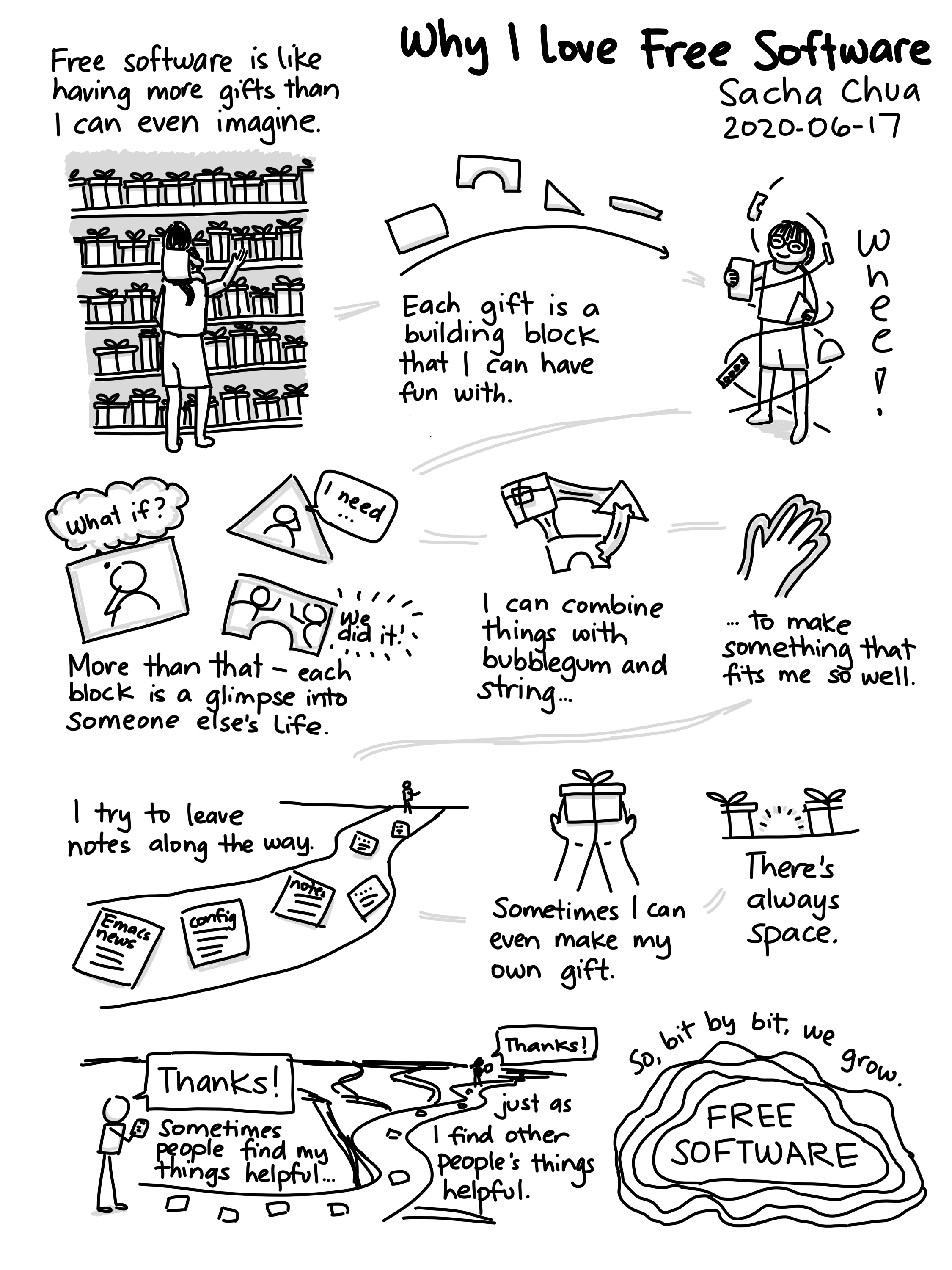
We can buy our compatriots' craft fair fare, give each other gifts and help each other knit our own gloves, but these things will never compete on the same terms or with the same approachability as the Big Players. Bit by bit, we grow, but they grow like tumors, encompassing all the lens society looks through. Pretending to straddle both worlds while standing apart from them like Purism is attempting to do can only lead to missed expectations and heartaches. There is no room for "premium" in the commons.
//sketches.sachachua.com/static/2020-06-17a%20Why%20I%20love%20free%20software.png
So I will be trying to get NixOS-mobile on my PinePhone this year, maybe eventually the Librem5, I'll try adapting my Complete Computing Environment to run my narrow suite of personal information management tools on it, but I cannot really recommend this to anyone even the die-hards, even less than I could in 2011, and that is sad. I hope Purism keeps making and selling decent laptops while improving their converged ecosystem for mobile handsets, but this is simply not worth +600 dollar+ 2000$ right now and it's a far bet to think it'll be worth 1300$ in a year.